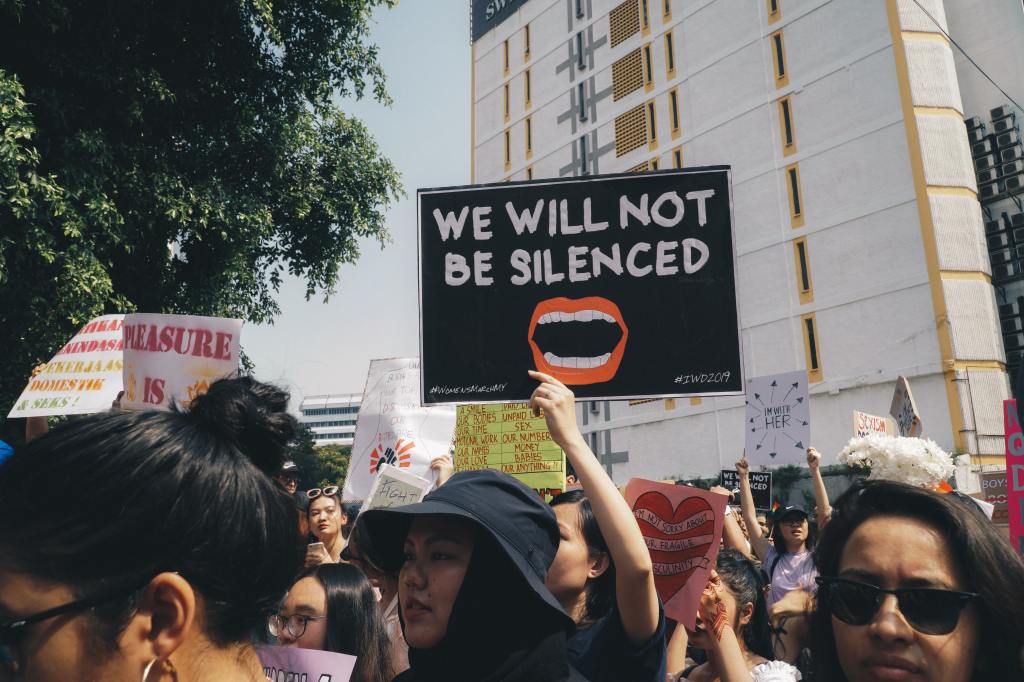
In case you didn’t know – today marks the 4th Annual Global Women’s March.
Since the 1990s, violence against women has gone from being something that only concerned feminist activists to becoming a key human rights issue around the world.
The Feminist movement began in the 20th century, focusing on the reproductive rights of women.
In the 20th century, Declarations signed by the United Nations promoted both gender equity and equality to women in the world – yet not all of these declarations have been put into practice in many countries of the world.
In the 21st century, the feminist movement shifted to focus more on women having the power to decide the trajectory of their lives.
Yet women today still have to overcome challenges of unequal economic opportunity, political disempowerment, gender violence, and human trafficking in order to achieve gender equality.
The Platform for Action produced at the UN’s 1995 Fourth World Conference on Women in Beijing, stated that violence against women was a human rights violation, and that the failure to protect and promote those rights and freedoms is a matter of concern that should be addressed. (Platform for Action, sec. D, 112).
No country can reach its full economic potential and achieve widespread prosperity if half of its population cannot fully participate in its economy.
The benefits of gender equality to humankind is immense.
The call to action
Many women human rights activists have faced assault and battery on behalf of the marginalized and oppressed, but their stories have remained mostly muted – with no mention of these women online / in-print. Amnesty International India in collaboration with Wikimedia Foundation, are publishing profiles of women human rights defenders in the country on Wikipedia – notably, Project Brave:EDIT.
Visibility on the internet is especially important for women activists – serving as the platform for recognition for their decades of work.
Activists continue to face hostility from members of their own family, and more often: to be sexually assaulted, threatened, intimidated, criminalized and even killed for promoting the rights of women, gender equality and sexuality; as well as growing pressure from politicians, religious leaders and violent groups, accusing the activists of “spreading politics of demonization”
“If you are a woman and from a racial minority, indigenous, poor, lesbian, bisexual or trans, a sex worker, you have to fight so much harder to have your voice heard by those in power,” said Kumi Naidoo, Amnesty International’s Secretary General.
If a social movement activist wants to change an institution, it makes more sense to use the domestic legal system and to exert pressure through that strategy, and only turn to the international spaces when they fail at the national level.
How some women have changed their world:
Saudi Arabia
Aziza Al-Yousef began her campaign against male guardianship after she and Eman Al-Nafjan were arrested and released for defying the driving ban on women in Saudi Arabia in 2013, only after their guardians were called.
The mahram requires women to legally have a guardian throughout their lives, usually a husband / father / grandfather / son over 18 years old / brother for access to work, marriage, travel and study and healthcare
After submitting a petition to the Shura Council (the Consultative Assembly of Saudi Arabia), she also began tweeting against male guardianship.
Studies have shown that Twitter served as a shared, safe, and alternative online communicative space that allowed women to transcend the gender segregation that existed in traditional public discourses and spaces of Saudi society, enabling women and youth to use these platforms to criticize political regimes and call for change and overcome boundaries of traditional state control – with less fear of severe penalties like those associated with joining street protests.
The #EndMaleGuardianship tweet was one of the two most noteworthy women’s rights campaigns of Saudi Arabia; the other being the #Women2Drive campaign, which peaked success when a royal decree in September 2017 granted women the right to drive – a transformative era for the Saudi society. In both these campaigns, Twitter helped mobilize women.
China
Chinese society is organized around the family and clan system, privileging collective rights and interests over individual and personal rights. This patriarchal ideology regards women (daughter, wife and mother) as well as children as dependent on and subjected as the property of men (father, husband and son). The organization of the Chinese state is framed against this backdrop. The state was often described as one big family, with each citizen acting as a member expected to obey the ultimate householder – the king. This strong hierarchical structure and the fact that its people were incognizant of their personal rights and interests, made it easier for the Chinese government to centralize power and therefore control how rights discourse is defined and mobilized.
Ideas about women’s human rights, and strategies to protect women from violence were adopted by elite women lawyers in China, and in one instance, led to the creation of a legal aid centre that is designed to change convention. Instead of helping individual clients, they focus on cases that can influence policy, such as allowing married women with children to attend university – which in the past was prohibited.
In this case, global values in Women’s Human Rights, are adopted and transformed to present these transnational ideas in terms that will be socially acceptable and useful – with or without direct knowledge of the regime – while at the same time ensuring it is different enough to challenge local inequalities and appeal to the imagining of the ‘new’.
The Agenda
The global women’s rights agenda is expressed through a set of national and international laws and practices (such as the CEDAW), international women’s conferences, International Women’s Day, and the theoretical work of many women and feminist studies programmes that have proliferated at universities over numerous decades.
These ideas are transformed globally from one context to another, adapting and reframing in order to resonate with and reflect particular national histories, with each new location – opening up different windows of opportunity for social justice and reform movements.
The meaning of human rights is fluid and open to grassroots activism.
How you can participate:
Letter Writing – A great way to put pressure on government officials is to send a letter focusing on specific local, regional, or national policy / law that you are calling to change
Tweet – #MarchForOurHumanRight #MyBodyMyChoiceMyRight #WhyIMarch #WomensMarch2020 #SheDecides
Support organizations that focus on issues of sexual and reproductive rights, sexual and reproductive health, period poverty, etc.
More noteworthy strategies to meet the challenges of gender violence include:
- empowering women to prevent or address gender violence
- an improved legal system
- upgraded institutions and services
- better trained reproductive health personnel
- cities which are well lit and where women are safe on public transport
- appointing judges specialized in gender violence issues
- increasing expenditure on infrastructure
- counselling women suffering this violence
- and, above all, education of men.
Mobilisation is the primary result that activists hope to achieve and is a pivotal step for action planning
 April Marie Canillo