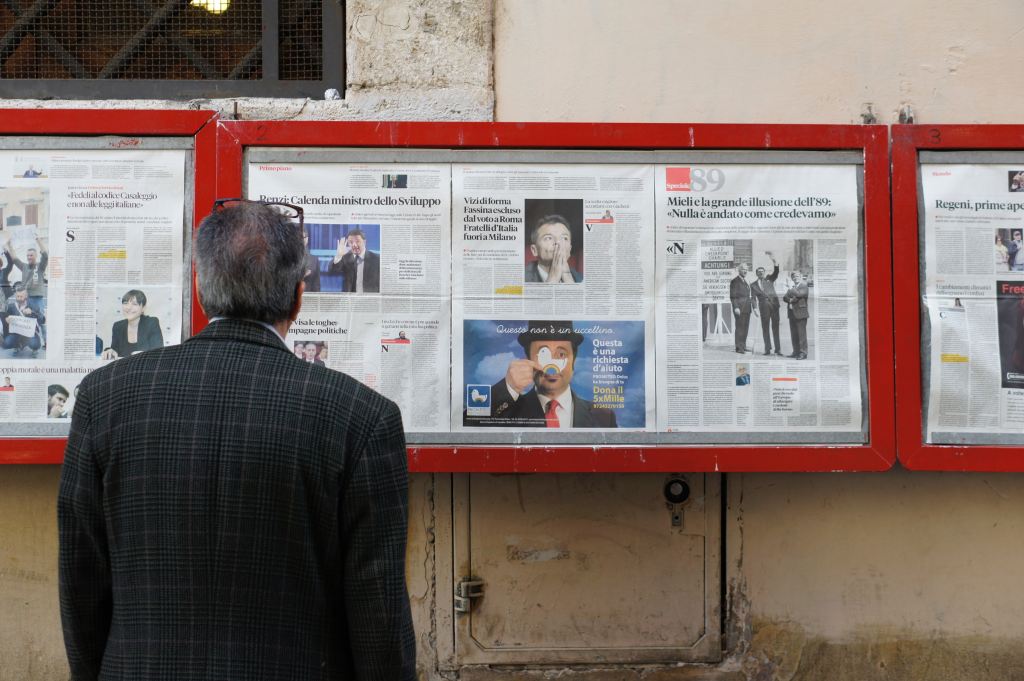
The abundance of accessible information means that consumers have the opportunity and capability to navigate and obtain news information whenever and wherever they want (Peters and Broersma, 2013). This communication revolution has enabled billions of people to both consume and produce news information in an active and informal ideas-and-knowledge-exchange marketplace (Bertino and Matei, 2015).
Though de-centralization of journalistic production allows information to be sourced from locations not previously accessible to professionals, and enables a greater range of perspectives and voices, it is only the professional editors and producers who had the time and resources to reflect and analyze, rather than just merely report (Peters and Broersma, 2013). This small community of editors have the responsibility of constructing the society’s daily social reality – building and connecting communities (Peters and Broersma, 2013) on the most widely-used knowledge resource (Bertino and Matei, 2015). The unequal distributions of power and intellectual resources on the internet and shrinking public trust flame the growing cynicism in established journalist outlets to act on behalf of the public’s interest (Peters and Broersma, 2013).
Credibility and reputation are established through human trust (Wierzbicki, 2018). In order to sustain credibility, journalists must report to the public with transparency, faithfulness, accuracy, and verification, in equal weight (Kovach & Rosenstiel, 2014). In the past, knowledge and expertise that shape public opinion were perceived to be possessed only by those who hold degrees awarded by higher-learning institutions or formal positions in notable organizations, however this has shifted – everyone can be a journalist, but not everyone can do journalism (Bertino and Matei, 2015).
Modern journalists actively connect with their communities, ultimately make good judgements, commit loyalty to citizens, and to actively analyze whether an opinion being presented is based solely on mere personal belief (Kovach & Rosenstiel, 2014). In order to better serve their communities, loyalty to the public must never be masked over by the journalist’s own culture, ideas, beliefs and personal history (Kovach & Rosenstiel, 2014). Quality credibility is the journalist’s commitment to loyalty to the public and pursuit of truth.
References
Bertino, E. and Matei, S.A. (2015). Trust and Reputation in Social Media Knowledge Markets [electronic resource]: Theory and Methods.
Kovach, B., & Rosenstiel, T. (2001). The elements of journalism: What newspeople should know and the public should expect. New York: Crown Publishers.
Peters, C. and Broersma, M. (2013). Rethinking journalism [electronic resource]: trust and participation in a transformed news landscape.
Wierzbicki, A. (2018). Web Content Credibility [electronic resource].
 April Marie Canillo