This report addresses Scott’s description of Weapons of the Weak as apolitical (Scott, 1985), and instead argues that the intentional, quiet, largely individualistic and prolonged acts of defiance of the imagined communities of resistors to the dominant power, are forms of tactical innovation (McAdam, 1983). These acts are motivated by the consciousness of the powerless, ultimately challenging the state, influencing social change and is therefore a social movement whose characteristics are dependent on the context of its society (Staggenborg, 2012). By defining the characteristics of a social movement, weapons of the weak, and quiet encroachment, and unveiling how each of these categories intertwine in 20th century and modern day authoritarian and democratic political environments, this paper will suggest that global media exposure along with the emergence of political art, and the Black Power Movement, are some of the clear ways in which social movements are tactically innovating to indirectly challenge political powers while ensuring the safety of the oppressed community.
A social movement is described as collective action of contentious politics that is sustained over a period of time (Staggenborg, 2012). Only within the context of certain structures and as a consequence of the creation of frames that people use to make sense of politics and motivate each other to participate, does the platform allow for political opportunities to give rise to social movements (Staggenborg, 2012). It is the degree of repression in the political environment, rather than the discontentment of the people that influences the initial motivation of the oppressed to challenge the oppressor (Fu, 2019). The attributes that bind the individuals within these collectives are its mobilizing structure and the collective understanding of the group affected (Bayat, 2013). Social movements are organized actions with a clear leadership; in societies that allow these structures to exist, these are thought of formally as large-scale non-governmental organizations (NGOs) and informally as kinship networks, trust bonds, and social media platforms (Fu, 2019). The collective understandings, or framing, of the problem and possible solutions can be strategically applied in order to rebuttal the counter-framing of the target group (Staggenborg, 2012). Social movements are dramatic expressions of citizens actively coordinating and advocating for change from their governments or other groups (Staggenborg, 2012). These contentious political actions can manifest into lobbying the government – but they are more than just angry mobs, these organized groups are coordinated, have a common long-term purpose, social solidarity, and are sustained (Fu, 2019). The group’s collective moral economy determines how people construct the meanings of why they participate in, and the goals of, the social movements (Fu, 2019).
According to Sharp, the success of a social movement requires only non-violent weapons be used (Sharp, 2013). Scott describes weapons of the weak as tools used by powerless groups as a form of everyday resistance, and can take the form of foot dragging, false compliance and subtle sabotage – amongst others – requiring little to no coordination and representing a form of individual self-help that deliberately avoids any symbolic confrontation with authority or the oppressor (Scott, 1985). These tools were effectively utilized in the massive peasant resistance in the 1930s that challenged the constant struggle between peasantry – those that relied on their labor for sustenance – and the group of citizens who extracted labor, food and resources from them (Scott, 1985). According to Scott, everyday resistance is the implied informal denial of public and symbolic goals, with no formal leader or organization, and is ultimately concerned with attaining immediate gains or meeting their pressing needs in relative safety (Scott, 1985).
Bayat describes quiet encroachment as a strategy most often used in urban grassroots to enforce a sense of power over their own lives and eventually influence state policy (Bayat, 2013). In this context, political democracy is instrumental in characterizing this form of mobilization as not necessarily contentious but rather a cooperative community engagement with some degree of control over decisions and outcomes (Bayat, 2013). In terms of quiet encroachments, these ordinary, quiet, unorganized, episodic and a mix of individual and collective direct actions and prolonged mobilization is characterized as a form of social movement because of the sociopolitical conditions of the region and the collective goal of achieving social and economic rights to be self-sustaining – more than just mere survival (Bayat, 2013). In the long-term, quiet encroachment strategies inspire a reality that the state has no option but to come to terms with, resulting in significant changes in their own lives, urban structure and social policy (Bayat, 2013). Generally these strategies are found under the sociopolitical environment of authoritarian or nonresponsive soft states that allow for the agency of urban grassroots (Bayat, 2013).
Staggenborg describes social movements as groups that use a variety of protest tactics in order to influence social change (Staggenborg, 2012). The 19th century abolition movement was one of the first social movements to use the tactic of organizing boycotts and sending petitions; many of the tactics today essentially use the same repertoire of contention that was established in the 19th century (Staggenborg, 2012). Social movements are sustained collective declarations aimed at the dominant power with a set of opinions and beliefs that represent a preference for changing some elements of the current social structure of their society (Staggenborg, 2012). The key to successful social change are cultural innovations – culture, identity and everyday life all have an impact on mobilizing outcomes (Fu, 2019). Generally it is assumed that movements with a formalized structure are better able to sustain a movement over time, whereas informal organizations are better at innovating tactics and action plans that illicit quick results (Fu, 2019). This report argues however, that tactical innovations in 21st century authoritarian and democratic societies, are utilizing the tools enlisted as Weapons of the Weak, in order to avoid danger while also publicly demanding change. Though the collective identity of social movements are continually being constructed, the following remains the same, and are consistent with the following case studies: movements identify the injustices, attribute blame, and propose solutions (Staggenborg, 2012). As in the case of the poor people’s movement in the midst of the black insurgency between 1955 and 1970, the community’s degree of ‘readiness’ in combination with political opportunity – a characteristic that is important to the political process model – allowed for the emergence of the Civil Rights Movement (McAdam, 1983). The trial and error of consistently devising effective responses to opponents’ counter tactics, largely determined the pace and outcome of the insurgency (McAdam, 1983). These cities where the most contentious conflicts occur, are sites where the pace of social change moves the fastest (Simonds, 2013).
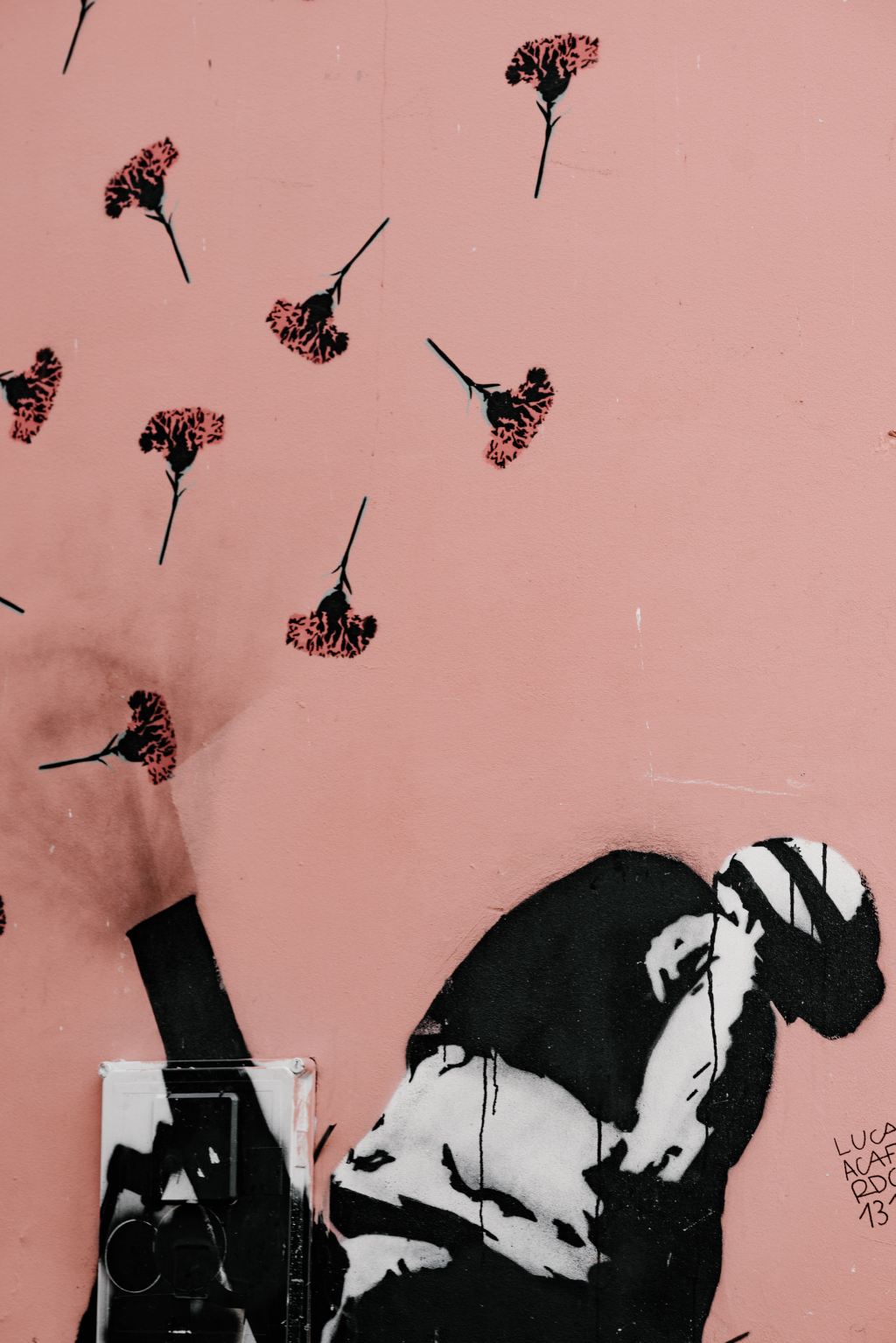
Activist art transforms the voices of those that are marginalized, and questions or ridicules authority in order to challenge the status quo; its origins and motivations revealing the culture and power that is operating within the environment (Simonds, 2013). Political artist Banksy, relies on anonymity to avoid risk and, like other artists of his kind, deliberately produces work that is emotionally and intellectually provocative, in order to use art as an empowering protective distance and non-violent weapon against injustice (Simonds, 2013).
The Israeli government’s justification for the creation of a separation wall that separated East Jerusalem from the surrounding uncharted areas of Arab land, resulted in the “ghettoization” of Palestinian communities – exacerbating social problems such as unemployment, drug abuse, and violence (Larkin, 2014). As a result, an influx of artistic resistance strategies such as graffiti and murals that decorated the wall, sparked international media interest; harnessing more public attention, as well as the attention of international street artists, peace activists, and conflict tourists (Larkin, 2014). The “creative resistance” of protest art and wall graffiti is used as a form of weapons of the weak, to challenge Israeli hegemony, project an message of hope, reclaim space, and express the oppressed voices as a visual petition that shouts louder than the politicians’ voices (Larkin, 2014). Similarly, the political wall murals of Basque Country act as visual frames and a form of political communication that express the arguments of the oppressed in a form that recognizes a shared visual knowledge that evoke emotion from the onlooker or target, rather than engaging in an argument (Rolston and Berastegi, 2016). Though murals and political street art is short-lived – subjected to fading effects of the sun and other environmental conditions, new media, and the images’ reproduction and distribution at a global scale, is a crucial new form of assuring the reach and success of the message of this form of non-violent, weapons of the weak, resistance (Rolston and Berastegi, 2016).
Artists of the Black Arts Movement that emerged in the mid 1960s had been inspired by the ideas and ideology of the Civil Rights Movement; rap artists in particular have been socially and politically conscious, delivering messages of self determination, raising student consciousness, economic solidarity and entrepreneurship, and a Pan-African connection through branding, sampling, and scratching (Cromartie, 2018). In this case, tactical innovations were acts or processes that involved any new thought or behaviour that differed from existing forms – through poetry or music, with the goal of increasing membership and awareness of social conditions like poverty, drug addiction, and racial discrimination, while also calling for the radical transformation of the existing economic and political system through artistic modes of mass communication (Cromartie, 2018). In the context of the United States Black Power Revolution, the dangers of violent confrontations and assassinations by members of the US organization, tactical innovations that were non-confrontational or anonymous proved to be an effective means of circulating the marginalized messages (Franklin, 2007). The relationship between activism, identity and culture in the Black Power and Rastafari movements revitalized new positive ethno-racial framings of the self and community that mobilized their socio-political and cultural efforts, influencing the rise of anti-colonial and anti-capitalist consciousness (Singh, 2004). The Rastafari movement in particular was formed under the conditions of intense alienation and dislocation in the Caribbean, and “Blackness” was used as a strategy to form a collective identity for racial mobilization in an attempt to reclaim history for the people of African descent that experienced colonialism and slavery (Singh, 2004). This romanticization of a shared historical-cultural experience did not necessarily confront political powers directly, but rather the imagined community and use of symbols and music, acted as a tactical innovation that indirectly questioned white power and white superiority (Singh, 2004).
The effects of globalization in mobilizing political art has created a space in which the oppressed are able to take political action without directly confronting authority, thereby avoiding risks to their safety. Visual arts, symbolism, music, and cultural forms of resistance are 20th century forms of weapons of the weak that have been successful in challenging the state in especially authoritarian or repressive political and social environments.
REFERENCES
Bayat, A. (2013). Life as Politics: How Ordinary People Change the Middle East. Stanford: Stanford University Press.
Cromartie, J. V. (2018). Black Social Movements Past and Present: A Comparative Analysis of the Black Arts Movement and the Hip Hop Movement. Journal of Pan African Studies, 11(6), 77+
Franklin, V. (2007). Introduction: New Black Power Studies: National, International, and Transnational Perspectives. The Journal of African American History, 92(4), 463-466.
Fu, D. (2019). Comparative Development in Political Perspective. Lectures 2 – 6.
Larkin, C. (2014). Jerusalem’s separation wall and global message board: Graffiti, Murals and The Art of Sumud. The Arab Studies Journal, 22(1), 134-169.
McAdam, D. (1983). Tactical Innovation and the Pace of Insurgency. American Sociological Review, 48(6), 735-754.
Scott, J. C. (1985). Weapons of the weak: Everyday forms of peasant resistance. New Haven: Yale University Press.
Sharp, G. (2013). How Non-Violent Struggle Works. East Boston: The Albert Einstein
Institution. https://www.aeinstein.org/wp-content/uploads/2014/01/How-Nonviolent-Struggle-Works.pdf
Simonds, W. (2013). Presidential Address: The Art of Activism. Social Problems, 60(1),
1-26. doi:10.1525/sp.2013.60.1.1
Singh, S. (2004). Resistance, essentialism, and empowerment in black nationalist discourse in the african diaspora: A comparison of the back to africa, black power, and rastafari movements. Journal of African American Studies, 8(3), 18-36. doi:10.1007/s12111-004-1011-3
Staggenborg, S. (2012). Social movements. Don Mills, Ont: Oxford University Press.Rolston, B., & Alvarez Berastegi, A. (2016). Taking murals seriously: Basque murals and mobilisation. International Journal of Politics, Culture, and Society, 29(1), 33-56. doi:10.1007/s10767-015-9204-4
 April Marie Canillo
Leave a comment